Technical
What Is a Self-Custodial Wallet?
A self-custodial wallet lets you control blockchain assets with your own keys. Learn how addresses, signatures, and wallet software work — and how the industry is making self-custody easier without giving up ownership.
By The 1Shot API Team
What self-custody means
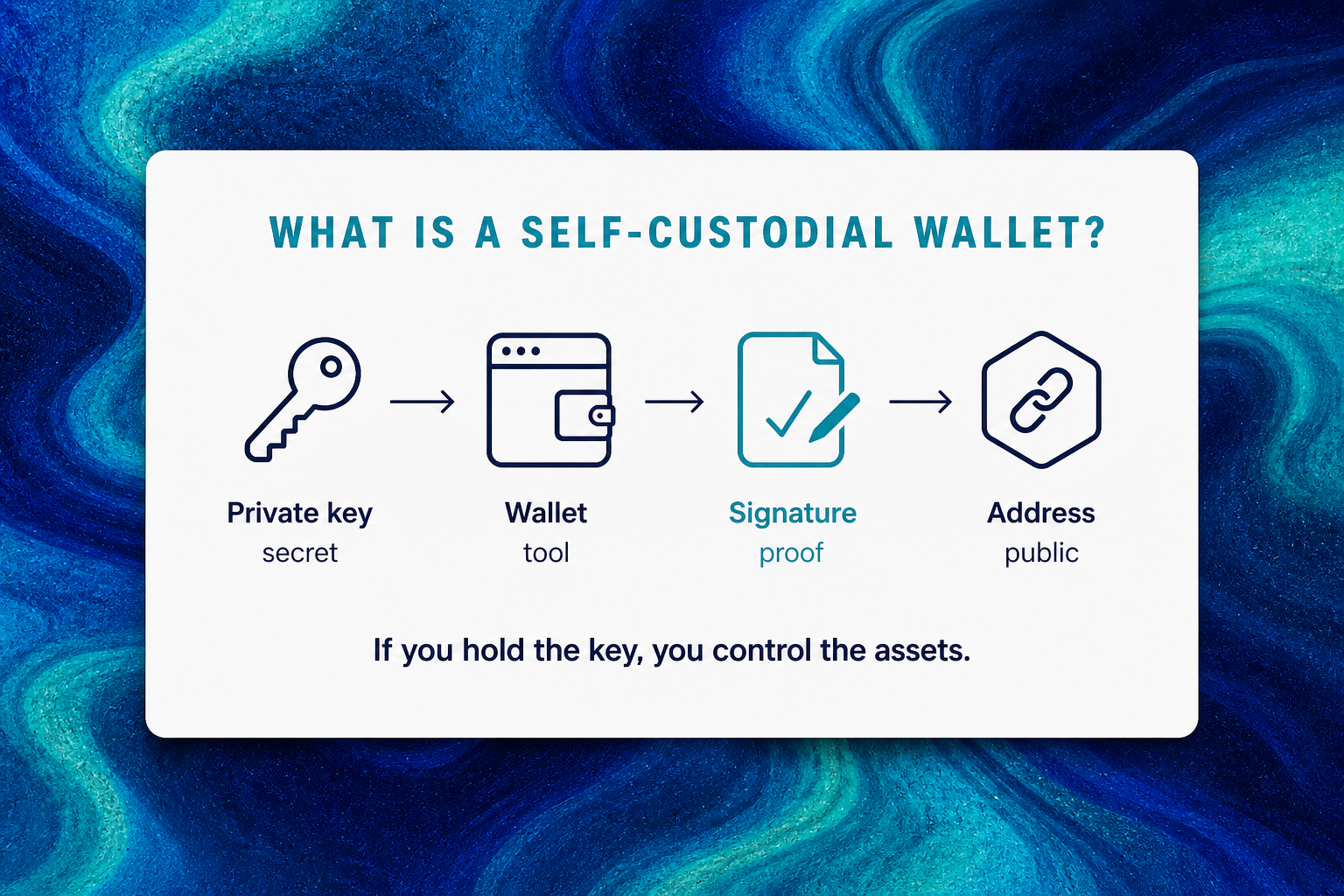
Self-custody has been a core cultural value of public blockchains since Bitcoin. The idea is simple: if you hold the keys, you control the assets. No bank, exchange, or wallet company should be able to freeze, seize, or move them without your approval.
That idea is easy to state and historically hard to use. For more than a decade, self-custody meant generating a secret, storing it yourself, and never making a mistake. Hardware wallets raised the security bar. Browser extensions made everyday use possible. Both still asked ordinary people to become their own bank.
This article explains what the term actually means, how a wallet differs from a key, and how the industry is trying to keep the property without the ritual.
In wallet marketing, self-custodial and non-custodial usually describe the same thing: you hold the keys that authorize transactions. Neither label is proof on its own. What matters is who can produce a signature.
Assets live at addresses. Ownership is a signature.
On a public blockchain, assets do not sit in an account at a company. They sit at an address (sometimes called an account): a long public identifier derived from cryptography.
Anyone can see the balance at that address. Anyone can send assets to it. Nobody can move assets from it unless they produce a valid digital signature.
Concretely: anyone can send USDC to an address like 0x7a3f...9c21, and anyone can look up what it holds. Only whoever controls the matching private key can send those tokens back out.
That signature is created with a private key: a secret number. The matching public key (and from it, the address) can be shared freely. The private key cannot.
This is the whole model in one sentence: the blockchain does not know who you are. It knows whether a request was signed by the key that owns the address.
A few implications follow:
- If you control the private key, you can authorize transfers, contract calls, and other onchain actions.
- If someone else obtains that key, they can do the same. The chain cannot tell you apart.
- If the key is lost and there is no backup or recovery path, the assets are still onchain — and permanently unreachable.
Self-custody is therefore a cryptographic fact about who can produce a signature rather than a legal concept.
The alternative is custody. When you hold assets on an exchange or a custodial app, the company holds the keys and your balance is an entry in its ledger. It can freeze the account, block a withdrawal, or lose the assets in a bankruptcy. It can also reset your password when you forget it. Self-custody removes that intermediary, and with it the safety net.
A wallet is not your keys
People say “my wallet” the way they say “my bank account.” That hides an important distinction.
Your keys are the secret. They can be written as a raw private key, a seed phrase (usually 12 or 24 words that encode the randomness needed to regenerate many keys), or material sealed inside a device or passkey.
A wallet is the software or hardware that holds or uses that secret and produces signatures when an application asks for them. MetaMask, Rabby, Trust Wallet, Ledger, Trezor, and an in-app embedded wallet are all wallets. None of them is the key.
That distinction is why self-custody has a second meaning besides “nobody else can move my funds”:
- Control. Only the person who can produce signatures can move the assets.
- Portability. You are not locked into one vendor's app. You should be able to take the same key material into other wallet software and keep the same address.
If you can export a seed phrase or private key and import it elsewhere, the wallet was a container. If leaving the app means losing the account, you had a product login, not self-custody.
Most self-custodial wallets let you bring your own account by entering a private key or seed phrase, and they will generate a fresh key if you do not have one yet. Generation is convenience. Import and export are what make the account yours.
How a transaction actually happens
Self-custody is implemented with public-key cryptography.
- You decide to take an action: send tokens, approve a contract, sign a message.
- Wallet software on a phone, browser extension, hardware device, or embedded web wallet uses your private key to sign that request.
- The signed payload is broadcast to the network.
- Nodes check the signature against the address. If it verifies, consensus includes the transaction. If it does not, the network rejects it.
No intermediary needs to “approve” the transfer in the banking sense. The signature is the approval. That is why a compromised website, a malicious approval, or a leaked seed phrase is so dangerous: the chain will faithfully execute a valid signature even when the human was tricked.
One category deserves special attention: token approvals. A signature is not always a one-time transfer. Many signatures grant a smart contract standing permission to spend a token on your behalf, sometimes with no cap and no expiry. A single careless approval can let a contract drain a balance weeks later, long after the user forgot about the transaction. Self-custody means those permissions are yours to grant and yours to revoke. It does not mean the wallet will stop you from granting a bad one.
Self-custody used to mean doing it yourself
For roughly the first decade of Bitcoin and the early years of Ethereum, self-custody meant the user generated a key and kept it safe with whatever software they could find or build. There was no consumer recovery flow, no familiar “forgot password,” and little room for error.
Two jobs fell on the same person:
- Do not lose the key. A forgotten password can be reset. A forgotten seed phrase cannot.
- Do not leak the key. Phishing sites, malware, screenshots, cloud backups of seed phrases, and “support” chats that ask you to “verify” a phrase are all ways of handing someone else the ability to sign.
That combination selected for technically confident users. It also created a market for tools that moved the hard parts into specialized devices or friendlier apps — without (in the best case) taking the keys.
Hardware wallets vs software wallets
Hardware wallets (Ledger, Trezor, and similar devices) keep key material on a purpose-built device. Signing happens on the device; the computer or smartphone typically never sees the raw private key. That is a high-security design. The costs are real: you must buy and keep the device, understand its UX, and protect it physically. A stolen, unlocked, or PIN-compromised device is still a problem. A destroyed device without a backup seed is a lost account.
Software wallets (MetaMask, Rabby, Trust Wallet, and many others) run either as an app on a smartphone or as an extension in a desktop browser. Both are easier to obtain and use day to day than a hardware device. Either way the user still has to install something before the first transaction, and the wallet inherits the security of the machine it runs on along with the habits of the person using it.
Two recurring software-wallet problems are worth naming because they are not theoretical:
- Cross-device friction. Mobile and desktop often need a bridge, QR link, or WalletConnect session. That is extra surface area and extra confusion.
- Phishing. A site that looks like Uniswap, OpenSea, or “MetaMask support” can ask the wallet to sign a transaction or reveal a seed. The wallet will sign what the user confirms. Self-custody does not protect you from approving the wrong thing.
Hardware wallets reduce some of those risks (especially seed extraction from a laptop). They do not remove the need to read what you are signing.
The new demand: self-custody that ordinary people can use
There is now both product demand and regulatory interest in making self-custody usable for people who will never memorize or bother to write down a 12-word phrase. Rules in several jurisdictions treat user-controlled wallets differently from custodial platforms, so whether a product actually holds user keys has become a compliance question and not only a design one.
The pull is not “make wallets slightly prettier.” It is:
- Onboard without a separate install and a lecture on backup words.
- Recover an account after a lost phone without calling a custodian who can also freeze the account.
- Stay hardened against phishing and malware as the user base grows past crypto-native early adopters.
Those goals conflict if you solve them the naive way: store the key on a company server and email a reset link. That is custody with extra steps. The industry's interesting work is trying to keep exclusive user control while changing how the user stores, uses, and recovers the secret.
How the industry is responding
Put the wallet where the user already is
Embedded wallets live inside the application that needs them: a checkout, a game, a neobank, a dapp. The user does not install MetaMask to finish a flow. From their point of view, they created an account. From the chain's point of view, there is still an address and a signature.
Embedding solves distribution. It does not automatically solve self-custody. An in-app wallet can still be custodial, or “non-custodial” in name while signing only works through the vendor's cloud. The educational test stays the same: who can sign, and can the user leave with the same account?
For the product category and those tradeoffs, see Embedded wallets explained. For the operational test (does access survive the provider?), see Who actually controls an embedded wallet?.
Recover without handing the whole key to a company
Classic self-custody failed many users at the backup step. Secret sharing (often associated with Shamir's Secret Sharing, and related designs used in MPC wallets) splits a secret into pieces. Any one piece is useless. A threshold of pieces can reconstruct the key.
Typical consumer designs store shares in different places: the user's device, an encrypted cloud backup the user authorizes, a recovery contact, or a vendor who holds a share but not the whole key. Reconstruction should require the user's intent — not a support ticket that reconstitutes the key for a stranger who passed KYC on the user's email.
This can be genuine self-custody: no single party can move funds. It can also slide into joint custody if the vendor's share plus the vendor's identity system is enough to sign. “We split the key” is not the test. Who can reassemble it, and when? is the test.
Use platform credentials the user already understands
A parallel path uses passkeys and WebAuthn (including the PRF extension) so the device's secure hardware participates in key derivation or unlocking. The user gets Face ID / fingerprint UX instead of a seed-phrase ceremony. Done well, the signing secret never sits in a vendor database. Done poorly, “passkey login” is only a front door to a hosted key.
Passkeys also complicate the portability half of the definition. A passkey-derived wallet may never expose a seed phrase to write down, so portability has to come from somewhere else: the same passkey working across compatible applications, a documented derivation scheme, or an explicit export path. A wallet that removes the seed phrase should still be able to explain how a user leaves.
This path is why embedded wallets and self-custody are no longer opposites. The remaining work is keeping portability and recovery as strong as the login UX.
A short definition you can keep
A self-custodial wallet is software or hardware that lets you authorize blockchain transactions with keys you control — such that nobody else can move the assets without your signature, and you can take that control to other compatible wallet software.
Everything else is implementation: hardware vs software vs embedded, seed phrases vs secret shares vs passkeys. The label is earned by exclusive signing control plus the ability to leave.
Frequently asked questions
- What is a self-custodial wallet?
- Software or hardware that uses keys you control to sign blockchain transactions. The network accepts the signature as proof that the owner of the address authorized the action. The wallet is not the key; it is the tool that uses the key.
- How is that different from an exchange or custodial app?
- A custodian holds the keys (or can sign) on your behalf. They can freeze or move assets under their policies. In self-custody, only a signature from your key moves funds — including if you are tricked into signing.
- Is "self-custodial" the same as "non-custodial"?
- In practice the terms are used interchangeably: both describe a wallet where the user holds the keys that authorize transactions. Neither label is a guarantee. A product can advertise either term while still requiring a vendor's servers to produce a signature, so trace the signing path rather than trusting the word.
- Can I still lose funds with a self-custodial wallet?
- Yes. Self-custody protects against a company freezing or seizing your assets. It does not protect against losing your key, being phished into signing a malicious transaction, or granting a token approval that lets a contract spend your balance later. The chain executes any valid signature.
- Is a seed phrase the same as a wallet?
- No. A seed phrase encodes the secret that can regenerate keys. The wallet app displays balances and requests signatures. You can usually import the same seed into another wallet and keep the same accounts.
- Are hardware wallets more self-custodial than MetaMask?
- Both can be self-custodial. Hardware wallets isolate keys from a general-purpose computer; software wallets are easier to use and more exposed to phishing and malware. Custody is about who can sign, not about the form factor.
- Do embedded wallets count as self-custody?
- Only if the user (not the host app or wallet vendor) controls signing, and the account remains usable outside that product. Embedding is a UX choice. Custody is a key-control choice.
- Does cloud key recovery mean the vendor can take my funds?
- It depends on the split. If shares can be combined only with your approval and the vendor never sees a signing-capable secret, recovery can stay self-custodial. If the vendor can reconstruct or co-sign without you, it is not exclusive self-custody.
Learn more
For a deeper look at in-app wallets and how they can preserve self-custody, see our embedded wallet guides and product overview.
Learn more about 1Shot Wallet